Barcelona's tourism board lists half a dozen Gaudí buildings beyond the Sagrada Família, each with its own ticket. For someone who wants to look rather than tick off sights, two houses on the same street are enough: Casa Batlló at Passeig de Gràcia 43 and La Pedrera (Casa Milà) at Passeig de Gràcia 92. This guide is about what to look at. For the timing, metro and ticket order of a two-stop day, see Barcelona: a two-stop Gaudí day.
1. Two houses, and why their details matter
They make a neat pair because one is a transformation and the other a new building. Casa Batlló's history page says the house was built in 1877 by Emili Sala Cortés, bought in 1903 by the textile industrialist Josep Batlló, and fully renovated between 1904 and 1906, with Batlló giving Gaudí complete creative freedom. La Pedrera was built from scratch between 1906 and 1912 for Pere Milà and Roser Segimon. In one you see Gaudí reworking an existing house; in the other, what he did with a whole plot.
2. Forms and materials, as the buildings document them
Both sites publish their own architectural notes, and they are specific. At La Pedrera, the architecture page says the façade is not structural but a curtain wall of more than 6,000 stone blocks joined to the structure by metal elements. The building stands on stone pillars and solid brick, which let Gaudí eliminate load-bearing walls, and two large courtyards bring light and ventilation to every flat. The wrought-iron railings on the 32 balconies are made from scrap iron, iron bars and chains. The attic is a succession of 270 brick catenary arches. On the roof are 29 chimneys, four metres high, and two ventilation towers, five metres high, that renewed the air in the attic, all clad in lime mortar and plaster.
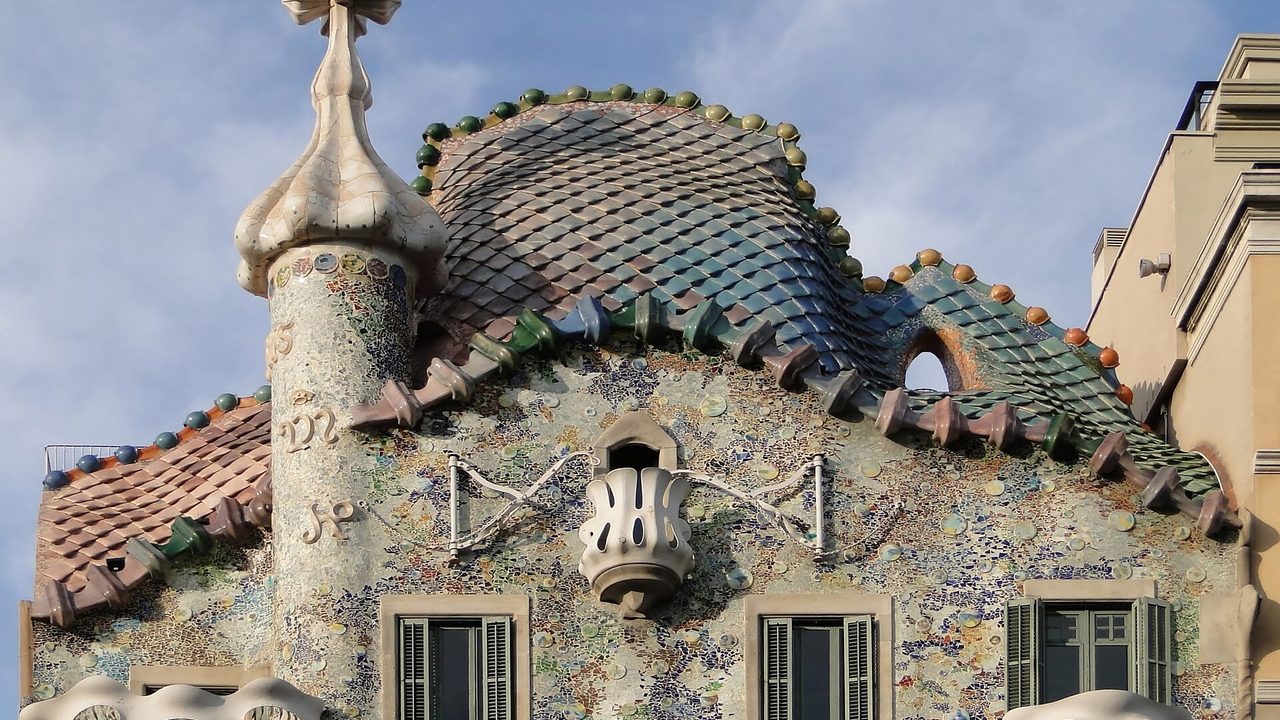
At Casa Batlló, the façade page names stone, glass and ceramics, slender stone columns in bone-like shapes with floral details, and balcony railings shaped like masks, each cast in a single piece of iron and fixed at two anchor points. The roof is made of large scales and topped by a tower with a four-armed cross pointing to the cardinal points. Inside, the light well is tiled in shades of blue, darker at the top and lighter at the bottom, while its windows grow larger towards the bottom; wooden slats in the lower windows open and close for ventilation. The attic has sixty catenary arches, and the roof has four sets of chimneys designed to stop air blowing back inside.
On symbolism: Casa Batlló's own page connects the roof to the legend of Saint George and the dragon and gives the house's nicknames, the House of Bones and the House of the Dragon. That is the house's interpretation; La Pedrera's architecture page sticks to structure and function. Read each as its source presents it.
3. Outside and inside: what each ticket shows you
| Casa Batlló | La Pedrera | |
|---|---|---|
| From the street | Façade, columns and mask-shaped balconies | Stone curtain-wall façade and ironwork balconies |
| Roof | Included in Silver, Gold and Platinum tickets, not in Blue | Included in the Essential visit; closed in the event of rain |
| Interior highlights named by the site | Main floor, light well, attic of sixty arches | Courtyards, apartment, attic of 270 arches |
| Visit length listed | About 1 hour 15 minutes (Blue about 1 hour) | About 1 to 1.5 hours (Essential) |
| Commentary | Audio guide in 15 languages | Videoguide in 11 languages |
4. A looking checklist for each stop
Casa Batlló
- From across Passeig de Gràcia: the stone columns, the mask-shaped balconies and the scaled roof with its cross.
- On the main floor: the oak doors with coloured glass set into them, and the undulating ceiling.
- In the light well: stand at the bottom and look up as the blue darkens and the windows shrink.
- In the attic and on the roof (if your ticket includes it): the white catenary arches, then the four groups of chimneys.
La Pedrera
- From the street: the stone blocks of the façade and the scrap-iron balcony railings.
- In the courtyards: how much daylight they bring down into the building.
- In the attic: the rhythm of the 270 brick arches.
- On the roof: the 29 chimneys and the two taller ventilation towers.
5. A small-group interpretation tour: what to check
Casa Batlló's FAQ says its visits are not guided; the audio guide is the commentary, and groups start at 11 people. La Pedrera lists two guided formats of its own: a Premium visit with a guided tour in English for a maximum of 6 people, including reserved areas, and a Sunrise visit with a guided tour in English and Chinese before the doors open to the general public. If you look at a third-party small-group tour instead, ask: does it include entry, or only the exterior? Which ticket tier, and does that include the roof? How many people in the group? How long is the walk between stops, and how long do you stand at each? What happens to the roof part if it rains? This site does not recommend a particular tour.
Physical demands to check: La Pedrera says it is only partly accessible, with lifts and ramps between floors; its rooftop is very uneven, reached by lift, and does not allow wheelchair access, and the maximum wheelchair width is 63 cm. Casa Batlló says a lift reaches the roof terrace and that wheelchair users can visit the whole house; it has no lockers or cloakroom, so travel light. Casa Batlló lists a €3 reduction from 65 years old on the page we read on 26 October 2026; check before you book.
6. A reading list and a relaxed visit plan
- La Pedrera: architecture, the source for the figures above.
- Casa Batlló: the façade and the interior.
- Casa Batlló: restoration notes, which log work from 2018 onwards, including the rear façade and courtyard uncovered in June 2025.
A relaxed plan: La Pedrera in the morning (its roof closes in rain, so keep an eye on the forecast and swap the order if needed), lunch on or near Passeig de Gràcia, then Casa Batlló in the afternoon. Casa Batlló's own directions put Diagonal station, La Pedrera's metro stop, a 10-minute walk away, and it suggests 4:00 to 7:00 p.m. as a quieter time for visitors using wheelchairs. Hours change on 2 November 2026 at La Pedrera (9:00 to 18:30 in winter), so check the date. For a port day, use the all-aboard worksheet; for the wider city, the Barcelona port guide and the Barcelona ferries.